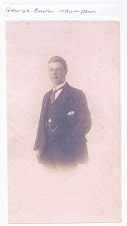
In the first place my father should have been shot.
As you read this autobiography you probably agree with me. I am now 71 years of age and suffering like hell with arthritis, in a wheel chair from which I have very little hope of vacating.
I had a very poor education at a council school, leaving at the ripe old age of 14 years, and had been under a master who didn’t know as much as I did. One boy in my class, Luke Dobie, was miles ahead of any of the teachers. So you will see I cannot put in any high faluting words like perhaps Denis Nordon or Frank Muir work use. In the first place I wouldn’t know what they meant.
Right from the age of about 7 or 8 I can never remember walking to school, I always ran as fast as I could; to school; lunch time and 4 o’clock home time, so consequently I was very fast on my feet; I was picked for the school team at 10 years of age for soccer and afterwards for Tynemouth boys, then the county, then for Northumberland and to play for England against Scotland and Wales. My speed was exceptional and I scored many goals.

War was declared in 1914, and this was where my father comes into it. It was a grand excuse to sack his man and put me in his place; a boy of 14 to do a man's work without any pay. Just to give some idea, I remember one morning I walked to the fields where we had the horses – about a mile away – and back another mile. I was grooming them down when he came into the stable and played hell with me for “letting half the day get over”. It was exactly 6.a.m.
Knowing I was only half educated I put my name down for Tynemouth Secondary School night classes and I started in the October of 1914. After about 6 attendances I got absolutely sick of getting home at 10.p.m. and then starting killing two or three sheep before I went to bed and this was after a 6 a.m. start in the morning… so bang went the further education.
One of my jobs was driving the cattle and sheep from Gateshead Market: there were no cattle trucks at this time and it was no easy job getting them through Newcastle. In those days, cattle were tied in stalls on the farms and had no exercise; consequently you might have some bullocks that had walked miles and were footsore and weary before I got them, to walk home another 12 miles. This was worse in April May and June at the end of the winter when they were straight from the byres.
I used to walk to North Shields to catch the train at 6.a.m. and leave Gateshead market at about 7.30 a.m. I remember paying toll on the Redheugh Bridge. After I had delivered the stock to Backworth store, Shiremoor Store, J Whitfield, Cash Dividend Store, and our own store, I was home about 11.45. Was there a cup of tea for me? Not on your life; there was a big basket of meat to deliver to customers up to three miles away and when I did get home; sat down to dinner – I was last of course – asked mother if there was any rice pudding, she said she was sorry but Charlie had had two helpings and there was none left. She usually promised me a good tea; but I just got the same as all the rest of them. I usually had a good sheepdog to drive the stock, and by gum you needed one.
One dog I had used to take fits, and you can bet he took a fit at long Benton where there happened to be three pubs. I had to go into one of them and buy a small rum, brandy or whiskey to pour down his through. It cost me a penny hap penny for a small one or 3d for a large one. It generally cured him, but if there were no pubs near, a pail of water over him did the trick.
I got the fright of my life one day when at North Shields Station I was sitting waiting for my train, when I was horrified to see the tail of my dog disappearing into a riverside train to go to Central Station; and found my dog waiting patiently for me on the Platform at Newcastle. My relief and joy was unbelievable.
My pay for the task of walking the stock to the shops was 1d per sheep and 1 shilling per beast. If a shop had three beast I got 2/6d, which was not bad pay.
One day one of our own beast broke away when I was putting then into the yard, and it ran all the way back to Long Benton, about 4 miles after I had walked 12. I got it penned on a farm at Benton and went up the following day and killed it; it had to be shot; it was completely wild.
I was often sent for pigs which we bought from a miner’s house in a street with the pig sty in an inaccessible place down the garden. The pigs had been carried through the house as little piglets and they forgot that the animal which came back was fully grown. The only way to get them was to bring them through the house and into the back lane. I found out that the best way to do this was to hold them by the ears and walk them backwards through the kitchen and out of the back door. Consequently I got to be a master at handling pigs.
When I was about 16 I was at Hexham agriculture show with some friends coming from the show ground. We heard a terrific noise from the pig pens. We went over to se what the noise was about and we saw 4 farm men trying to get an enormous sow into a pig cart; we watched for a while. It was a hot day and the men were all sweating away without much success. After a while they were resting and I volunteered to put the sow in for them. There was laughter in the pen; but I got in the pen and took hold of the sow’s ears and rammed my foot on her nose. She backed straight into the cart without any bother amid much applause from the crowd.
When writing these memoirs I might take a jump back a few years as things come to my memory that I have missed out, I must tell you the story of the black cat we had,. He just walked into the shop one day as we were killing a beast. We usually picked up a scrubbing brush or something and let fly at the cat. I missed him and he ignored me, just as though I wasn’t there. Ten minutes later he had a mouse, a few minutes later, another, so I made him very welcome. He would come and sit on the bench as soon as the liver was taken from the carcase. We got no peace until he received a lump with the warm blood in it; he never bothered if we were killing pigs or sheep – it had to be from a beast.
Every Saturday he would walk to the school, let himself in though a window he could open himself and caught mice all the weekend. His only drink was water, even water that had been used for washing dishes; he would never look at milk.
When coming through Newcastle with the beast and sheep, I used to walk with a slowing pace when I was nearing the “cradle-well” so that the beast could get a drink. One day the beast saw his reflection in a shop window and pushed his nose against the pane – bang – it cracked right across. I was off with a rush and away with the beast before the owners arrived. The Cradlewell is still there in Jesmond, but there are no horses or cattle to use it now.
I was first out of school as usual and in the schoolyard was a football, well not quite, it was a football case and some of the local boys had found a large stone to fill it and placed it temptingly in the schoolyard. “Kick it over, Baden” was the shout and I did, to my sorrow. I went flat and the ball never moved an inch. I had a good laugh with the boys when I recovered.
The bulk of our business was done from carts in the streets, and no matter what the weather was like, I was leaving the shop before 8.30 a.m.; you had to be in the shop at 6.a.m. to cut and prepare joints. One of our customers was the tenant of the Pineapple Inn near Percy Main; and behind the pub he ad a market garden with a small one horse plough. May father was determined to buy this plough and he did, eventually. Came the day he was going to use his new toy, (My half day off) It was not long before he found our horses were too light, and the harness no use for the job. I was pulling the horse; my father was pushing the plough; it was hopeless, so eventually borrowed a farm horse. And (on my half day off) we got the garden ploughed. He never paid for the use of the farm horse; I was lent out (on my half day off) to the farmer for stacking hay. Usually on the ladder at the side of the stack, the heaviest job on stacking day. If my father had given the farm hand 5/- he would have done the job, but no, everything cost him pounds his own way.
My father was a dab hand at lending out money. He was at last making some, having me working for nothing and at all hours of the day and night, and it seemed to go completely to his head. He lent money to anybody, without a cat in hells chance of getting it back. We got our horse shod at the blacksmith, and never paid; the wife of the blacksmith and got her meat and never paid, the landlord of the pasture field did the same thing, and when, eventually, my father died, I just scrubbed out the lot, it was impossible to get things squared.
When I come to think of the conditions our family of four boys and three girls were brought up I am amazed that we all survived. The slaughter-house was next door to the kitchen; you could walk straight from the kitchen into the killing shop. The one lavatory was in the backyard and all the refuse from the stables, the guts from the beast, sheep and pigs, and excreta from 9 humans went into this midden. It was my job to clean it out; I started at 5.a.m. to do the job so that I got the smell away before the public got about – but the flies – They were there by the millions, you could put up fly papers anywhere and within a few minutes they were black, and had to be renewed. Why we all did not die of food poisoning, I will never know. We had no fridge and meat was fully exposed to heat and fly damage.
I was getting near 18 years of age, and calling up time for the forces. The First World War had been on for 4 years, and it was then all conscription, so I had little choice but go where they sent me. I opted for the Marines because they did their training in a Deal, Portsmouth and Plymouth. I decided on this because I had never had a holiday, and these were the farthest away places in England. I did most of my training at Deal, and Plymouth, the boys were grumbling about the hard life, to me it was a piece of cake. Albert, my younger brother came into the business to do my work, as usual for nix, and Eleanor, my sister served in the shop, again for nix.
The army pay was 1/- per day, so you could not have a booze up too often, but I found I could manage. I was very fit and strong, in the tug of war team and very successful against all the army teams till we met the South Africans and they gave us the knock.
Home again after discharge I went into the business with Albert, determined to build it up. He was more of a mechanical mind than I and he thought we should have vans. I loved the horses, however he got his way and we went over to vans.

Before the business really got on it’s feet we played football on Saturday afternoons, and that is where I broke my ankle, the first cause of my arthritis. It was just bandaged up and back to work again. My father never looked at it, he was afraid I was going to be off work for a few weeks. It eventually healed, but it was out of shape, and very sore at times. I went to several surgeons later, and they all said the same thing, and that was that it should have been cut open and all the splintered bones taken out. I decided to go to Gordon Urwin for the operations but he did not make a very good job of it. And it has bothered me for many years.
I was very fond of tennis, when I could find any spare time, and we decided to make our own tennis court. I levelled off a part of our hayfield, turfed it, rolled it, marked it, then I started to play golf and never played one game on it. I enjoyed golf better.
By 1921, Albert and I were working long hours often out with the vans until after midnight in any sort of weather. By this time there were cattle trucks on the road, and we were finished with the long treks from the markets. As I am writing this I notice the price of fat beast to be about 120 to 130 pounds. When I was about 20, we could buy then for about 17 to 20 pounds. What a change.
I played golf at every opportunity and became quite a fair hand at it; getting down to a 4 handicap. One of my greatest days was playing Max Falconer off level and beating him, he won the open championship 3 or 4 years later (after the 1939-45 war)
I got married in 1922 to Molly Elliott and went to live at Whitley Bay with her aunt, but this was not satisfactory and we came back to New York.

Molly and Baden at Cresswell 1933
My father had a piece of land at Murton Village and he thought he would make a fortune building houses; what a laugh: he knew nothing whatsoever about building, and I thought he would loose all the money that Albert and I had made for him. He got two built, and that was enough. I lived in one of them for a few years and kept, or my wife kept, about 100 head of poultry. I had seen a quite modern, roomy, fridge for sale but father would not “bite” so I begged the money that my wife had saved from selling eggs, and bought the fridge. What a godsend. What a wife, she had saved and saved and I took it away in one fell swoop.
Some time in the 1920’s I bought a 2 seater Morris Cowley for 11 pounds 10 shillings. It was the best car I ever had, and I wish I had it now, I taught my wife to drive and the pair of them were invaluable. One Christmas I bought about 40 pigs and left about ½ of them for New Year. When out in the van at Shiremoor I realised that I was going to be very short of pork and this was about 9.p.m. the day before Xmas eve. I rang up my wife and told her the position. Could she get 3 or 4 pigs home for me to kill – and this was about 9.00 p.m. on a cold winter’s night. We had a servant girl living with us at the time and what a gem she was, she got the boiler fires going while the wife got the car out and away to the farm they went in the two seater. When they got there the farmer was ill in bed with the flu, but the wife borrowed a hurricane lamp, and away to the pig sty. They got one pig into a sack, and loaded it into the tiny “dicky” seat and off home. Back again for another and another until she had four 8 stone pigs home before I arrived at 11.00p.m. An 8 stone pig is about 12 stone alive. I got straight on with the slaughtering. The two women laboured to me and I was in the house for supper before 12.p.m. The position was saved for the Saturday morning. But not a word from the old man on Saturday morning when he arrived.
My two other brothers were not in the business. Edward and Charlie put nothing into it but took everything out of it. But I remember my sister Evelyn handing over her wages at the end of the month! A most unfair position. My father died very suddenly in 1933 and a most awkward situation became obvious, as Edward was one of the executors and I think he wanted to sell the business and split the proceeds 7 ways. HE
was alright with a sound haulage business; Charlie bricklaying and earning good money, but Albert and I worked for our food only.
Note: this is a copy of the assets of George Thompson Snr at the time of his death, with a summary of the split of the assets between the seven children, Edward, Baden, Charles, Albert
, Evelyn, Eleanor and Dora
Albert was telling me the other day, when I was in the army, he walked the cattle and sheep from Acklington market during a rail strike. My uncle took him up in his car as he was going to Alnwick the following day. Albert had all the beast and sheep for the whole area and Acklington is about 30 miles away. He had to manage this single handed.
He had a dog with him but every time they passed an open gate the cattle would wander in. One farmer asked where he was headed “Shiremoor”. His dad had only given him 2/6d and expected him home in a day. The farmer took pity on him, sheltered the cattle ands gave him a bed for the night. He made it home the next day.

The week after father’s death a local farmer rang me up to come and see him about some fat beast at the farm. I made a deal with him on the price of the last three beast he had inside., two at 20 pounds and 1 at 18 pounds. The 18 pound beast, when killed was full of tuberculosis. I got an awful shock when I learned that my father had not been insured against it. However when I rang the farmer and told him his beast was condemned, he promptly told me it was not his beast but mine. It was a shocker having one of three beast condemned, and asked him if he would meet me halfway, at 9 pounds each, but he would not hear of it. However I know that HIS father had been fined two years previously for selling a cow to a butcher well knowing it had T.B. and I was fairly sure this bullock had been a calf from this cow. I went to the solicitors and explained the case to him. The junior solicitor wanted to fight the case, but his father said, no the farmer was legally right, but he suggested offering him ½ the price, which I had already done. This time the farmer accepted my offer of 9 pounds and everything was alright.
Before the First World War and between the two wars, there was much T.B beef sold in the shops, I myself, could kill and dress a T.B. bullock so that a meat inspector would have a difficult task finding that the beast was deceased.
After father’s death, Albert and I were in business as Thompson Brothers and we sold some quantity of meat; when he was leaving the shop he put me to shame, sometimes with the load of meat he took out, coming back with just a few bones. Friday was our biggest night and we were often out until midnight. The customers used to wait for us no matter what the time.
I used to go to Borough Park occasionally, on a Saturday night to the dog races; and I have two amusing stories of these occasions. The first one concerns my wife, she had never been to a dog track in her life, but on this occasion I told her to get “dolled up” and I would take her out to supper, if she had known I had Borough park in mind it would have been a decided “no”. However I had her in before she knew what had happened. I gave her my solemn promise that I would come away as soon as she tired, and asked her if she had any money, the expected answer came “no” so I gave her 5/-. I knew she could not do so much damage with that. I lost her after supper and only found her when we got into the car to come home. She handed me 14 pounds and I said “my goodness, you have done well, but I don’t want his, you can keep it “oh” she said, “I’ve got another 14pounds, so you can have that” 28 pounds from 5/- and she has never been since!
The other story was one night I was there and I saw a farmer friend of mine always collecting from the tote payout: he was loaded: so I asked him for some information
“You seem to be doing well John; can you give me one for this race?” (He spoke very slowly so I spoke slowly too. He went through his pockets,
“What race is this?” he said very slowly
“The fifth” I said
He found his card at last and after studying it for some time said “well, I have no 5 for this one, no 2 the danger, but I’m going to back no 4” (there are only 5 dogs in each race).
I think the best night I had up there was a night I had with a blind man. He had been blind from birth, and was a master hand at picking winners.
My sister, Eleanor, Married William Stewart of Ears don, and had a farm on the banks of the river wear. One Sunday I thought I would like to go and see her; a friend had promised me the use of his tandem if I wanted it. I thanked him and we set off for Sunderland, me in front and my wife, behind. I’ll never forget that ride as long as I live; if we were going right, she was leaning left, and if we were going left she was leaning right – always the wrong way. It was my first ride on a tandem, and the last.
About 1922 the manager of Sunderland football team rang us on the telephone and asked if Albert would go over and talk terms wit him. Albert took some persuading, but finally I got him to go. He was offered the same terms as Charlie Buchan, but he refused, and I think for one reason only; he was thinking of the ton of work I would have one top of my usual. They signed up Dave Halliday.
The business got so big that we were out with the vans until 8 and 9 p.m. even on Saturdays; I remember on Christmas week I got home at 12, midnight. I told my wife I had locked up the shop. “Well, you had better take the bolts out, Albert is still out.”
One or two stories of shop life, and a glimpse of how nasty some women can get. My assistant was serving a woman, there were several in the shop at the time; she was just leaving when she suddenly called out that one of the eggs she got last week was bad. Dave said, “But we do not replace eggs”. (It was hot weather) but she would argue.
“Give her an egg, Dave, and get her out of the shop”. He handed her a fresh egg, and she was almost out of the shop when she turned and pushed her way up to the counter. “It was a large egg, not a standard” she called out, and handed the egg back to be replaced with a large one.
Back to the slaughter house: you often hear of cattle dying through eating plastic bags or some other rubbish. It is no fairy tale. I once got a whole motor bike inner tube out of a bullock’s stomach. It was cut through, and had been swallowed, by the beast, not because he was hungry, but because once they start chewing something they have to take it all down. The tube was in one straight length, having been cut through once, but it was complete with valve.
Being a butcher in the country, you are often called out to kill a bullock which looks like dying, and when the war was one, meat was really scarce, so you jumped at the chance of getting a few stones of beef on the cheap. I was called out one night in 1946, whilst rationing was still very strict, to kill just such a bullock. I shot it, skinned it, gutted it, and tried to buy the carcase, but as the farmer was just the farm steward, he could not sell it to me. The carcase went in stead to Newcastle for distribution among the butchers of the “Meat Pool”.
What a lucky man, I was, the carcase was found to have advanced anthrax, and had I cut myself whilst doing the job, the chances are I would not now be writing this today. Anthrax is nearly 100% fatal – or it was a t the time. If I had got the carcase I would have sold it to all my customers with perhaps many deaths, good cooking kills most germs, but there would have been many at grave risk.
A rather amusing story from this rather serious affair concerned my son-in-law Jack Cooper; I had taken him up to the farm, thinking he might be able to give me a bit of help. He was home on leave at the time. He returned to Portsmouth before they found the beast had anthrax. The police were anxious to have him examined as soon as the truth about the bullock was known, but it was the following day before he got the telegram to have a medical and merely lined up on sick parade. The M.O. saw him waiting, and said
“What on earth is the matter with you Cooper?”
“I’ve been in contact with an infected cow” he said. At which he was curtly told to stand in line with the others. However when it became known that the cow was 4 legged and anthrax was involved, it created quite a flap.
When I was serving with the marines in the First World War, I was walking through the village of Tavistock, where I was stationed. I saw a slaughterhouse and was into it like a shot. I met a butcher there and saw him cleaning tripe with lime. I had never seen this done before, but as soon as I got home I adopted the method, and used it till the day we were stopped killing our own stock.
I’m afraid I treated my wife rather roughly. She was now driving the car very well and taking out a few orders to customers, but within a few weeks she was taking out loads of meat.
The examination of meat before 1940 was very haphazard, we seldom saw meat inspectors and tuberculosis was very prevalent. Pigs were often T.B. and so were cattle, but sheep and lambs were seldom infected. It is not surprising that many young people died of TB, today it is almost extinct, and there is seldom any danger from eating any meat now.
Going back to earlier days, I was walking the stock home from Gateshead Market, and I was at Heaton cemetery with about 20 beast and 60 sheep, when in the distance I saw a brewer’s wagon coming rather fast. I waved my arms signalling for them to slow down, but on he came, much to fast. He ploughed his way into the sheep, I as so amazed at the sight of him going over the sheep that he got away without me getting his number. Three sheep were killed and three with broken legs. I bled the dead ones at the roadside, and the injured ones I got into a farm cart which had been to town with hay, and asked the man to leave them at the butchers in Benton, beside the Black Horse Pub. I killed and dressed them when I got there. I was not fifteen years of age at the time, and thought nothing of it.
On another occasion I had a sheep run over with a railway wagon, right across his back – the driver told me he had two tons of drain pipes and the wagon weighed 1 ton. But that sheep walked from Benton to New York, 4 miles. When it was killed one of its kidneys was loose among the intestines and its ribs were smashed to pieces.
We hear lots of stories of the hard times of the unemployed today, but I hope there are not many to equal my story of one unemployed man of 1947. This man had a large family, but as I remember to my knowledge I had never known him work. On this particular day he jumped off the bus right at the door and came into the shop.
“Have you any sheep heads, and mind, they are only 4d in North Shields” he said.
“Ah” said I “but do you know how much they are here?”
“No” said he, “they are for nothing, free” said I “come into the back shop”. And I sharpened a knife for him to take off the skin and showed him how to do it, and with all the time in the world he made no attempt to skin them. He wanted me to skin them and clean them, but he went out sheep headless.
At this time the council had started to build nice quality houses on the outskirts of the village and this man was determined to have one, he was never out of the council offices and they promised him one of the first to be built. They had never seem the house he was occupying, although it had been entirely new four of the six windows were covered with sacking, almost all the cupboard doors were burned for firewood, he had knocked a hole in the wall between the kitchen and the scullery so that dirty dishes could be handled more easily. I got the chairman of the Housing Committee to come up and see it, and that was the last he saw of his new council house. He never knew who had shopped him.
When I was discharged from the Marines in 1918 the business was growing very fast and I found we had so much work to do in the killing shop that Albert and I decided to do all the killing early on Monday morning, so early in fact that we started at 12 midnight Sunday night, worked through the night and all the next day, till about 6 p.m. Monday. – All the dirty work was done in one day, beast killed, tripe cooked, black puddings made etc.
Back at school again, we had an assistant teacher, Mr Barker, easily the most efficient, at the school, when he saw that I was going to be a good footballer he used to take me to the spare room and give me a really good massage, and he did this during the morning break. I’m sorry to say he went to France, and was killed almost immediately. he had not been in France a week.
A day out with my horse and cart selling meat; I had served my last customer at West Moor and was heading for the main road home, it was about 9.p.m. and there had been a sharp shower and a quick frost put a coating of ice on the top. It happened one time in October, and I had not got the horses prepared for frost. Down went the horse, and it was easily seen that it was impossible for hi to stand on his feet. After his second fall I knew what I had to do, take him out of the shafts tie him to the rear of the cart and get in the shafts myself. I pulled the cart home myself about 5 miles, I got help from 2 miners at Benton square to bush me up the Bridge Bank, or I would not have made it.
We had a very smart horse about 5 years old with plenty of action, the farmer in the village used to run the football team to the away matches on alternative Saturdays in the Tyneside league. It was a wagonette affair for two horses. One of his horses was poorly so he landed at our shop to borrow a horse to get the team to a place called Windy Nook. It was about 14 miles, almost all uphill, and to cut a long story short, our horse pulled the waggonette full of men himself and the other horse as well. The horse was no good after that journey, it broke his heart (not to mention Dads heart too).
When the time came for changing horses for vans there was quite an accumulation of harness and lamps etc. We had a scrap man took the lot for 3 or 4 shilling. A few years later the lamps alone were worth pounds.


When the Second World War came I was appointed fire officer with all the fire appliances in our stables and I could call upon half a dozen volunteers to come to any fire in the area. We had an air raid very soon afterwards, incendiary bombs all over the place. Some fell in the haystack at Watson’s farm and away we went to deal with it. We got everything fixed up and I shouted “turn on the water” the resulting flow of water was like a little boy of 5 having a “jimmy riddle”. There were escapes of water all along the hose. Unknown to me Brother Edward had spilled some acid from an accumulator, and it had dropped through the bench making holes all over the fire hose. I’m afraid the fire was the winner.
After the Second World War, I got a bit interested in the stock market; I had about 900 pounds in the bank doing nothing so I told the bank manager to buy me some shares.
“What kind do you want?” says he,
“Well” I says “some firm with a Jew at the head of affairs - what about great universal stores?”
“It’s your money” he said “and you can do what you like with it”
If I had read the financial time for a whole year I could not have made a better choice. He bought me 810 at about 23/- per share. No wonder they were christened “gorgeous GUSsy” I have had my money back many times over. Although they were so good, I never bought any more, spending my money on other firms such as Hoovers, Rank, De La Rue, Lloyds Bank etc. All of them good but not in the same race as G.U.S. If I had kept on buying G.U.S. with all the surplus cash and ignored the others I think I would have been worth a million by now.
My brother, Edward, Sam Abram, and myself were idling down Murton lane one day: we were just three boys together out walking, when we came across a man with a car through the hedge. He was stupid drunk: we helped him get his car onto the road, when a policeman arrived
“Do you think you can take it home?” he said:
“Give the handle a turn and I’ll drive.” said the man.
The policeman asked us boys if we could go to North Shields with him to see him safely home: Sam and I got into the back, and Edward got into the front seat by the driver. We had gone about a mile when the driver drove the car into a stone wall. Sam and I pulled him over the backrest and Edward got into the driving seat. We got the car started with Edward at the wheel, although he had never been in a car in his life, he drove it to the man’s shop and from there to his home. In first gear all the way. The man was a pork butcher and rewarded us (butchers sons) with 2 pounds of polony sausages which we through over the wall on the way home.
Sam Abrams was rather a clever lad, and I remember him dashing along to our house with a home made wireless set, and we got all excited when we heard Cullercoats clearly “pip, pip” and an orchestra in the distance; we thought it was wonderful.
Between the wars meat got very cheap, and I was selling excellent brisket at 41/2d per pound. Old Mrs. Hindmarsh had a corner shop at Bertram place and she used to buy a whole brisket off me on a Saturday (it only cost her about 7/-) All the travellers, butchers and greengrocers, went there for their dinner. She was a beautiful cook and the meat was on the table, with bread, pickled onions and beetroot. You help yourself to everything, cut your own meat and ended with coffee with milk – all for 1/-
One of our local farmers took the prize for the best story of the year; he had an old woman working on the farm, well she looked old, but as a matter of fact, she was just middle aged. All the dirty jobs were detailed for her. Granny Hindmarsh told me she was really the daughter of the farmer himself, but he refused to accept her. A young girl some years previously had put the baby girl on the doorstep and walked away. She slept with the cows, and went into the fields in all weathers to cut turnips for the cows, and this kind of life had made her look an old woman before she was 50. The hind was cutting turnips out of the fields when he came across Margaret, lying dead. He came back and told the farmer. “Well now” he said “when you go back for the next load, just fill the cart three quarters full and bring her back.” She came through the village with both her legs hanging over the tail end of the cart, on top of a load of turnips.
When we were finished with the horses we were also finished with the fields and we had about 2 tons of hay left in the stack. Father sold it to a farmer for GBP5 per ton, but it was a sorry story when we tried to get the cash for the sale; she took no notice of bills, so my wife thought she might be successful if she went to the farm herself. What a hope, she didn’t get a penny piece. That farmer was the master dodger. He had the cheek to go to a farm sale in Ponteland and buy a farm without any money, and he managed to stay put for about 3 years before he was thrown out. Broadlaw was the farm, and it has now been taken up with Kirkley Hall.
Arthritis was beginning to take its toll now and I was thinking of retiring early when brother Edward took ill., He had a severe pain in his chest, and they decided to operate; they cut him open and sewed him up immediately. He had killed himself with smoking. He lit one cigarette off the stump of the last one, and both his lungs were in a dreadful state.
He had a new car delivered the week he died, but he never saw it. I had been a fairly heavy smoker myself at the time, but determined to give it up and I was successful. I have no craving for tobacco now. I think this was just in time.
My investments were doing well, so I decided to retire, but I did not like the idea of total retirement so decided to find another job for a few years. Adam Lythgo of Warrington wanted salesmen for basic slag, lime and other farm manures so I applied for the job. I met the Newcastle branch manager and at the age of 55 got the job.
I had too weeks training at Warrington, and 3 weeks staying at the Imperial hotel at Newcastle. It was a very pleasant job and if my leg had been kinder to me I would have stayed with them for a few years. The commission basis of pay seemed generous, and some of the men were lifting GBP100 per week (in 1955 terms) I started to look for a site for a bungalow and found one at Old Hartley, near Whitely Bay, and saw the start of my bungalow being built. A house would have been no use to me as my leg was getting rapidly worse.

In the garden of the bungalow 1960
Before moving to the bungalow I took my wife to Italy for a two week holiday and enjoyed every minute of it. The trip was organised by the beekeepers association, who have a conference every three years and a different country is selected each time. I had decided to keep a few hives of bees as a hobby and what a rewarding hobby it turned out to be. The amount of honey gathered was astonishing and we had some enjoyable outings to apiaries all over the country.
Vast changes in the style of living have come about in these last few years. When I left the business about 13 years ago, men used to boast if they were having chicken for dinner, now the boast if they are having beef. Such has been the change in prices in these last few years. We have a lovely view from the kitchen window. I can see about 30 to 40 half-grown beast in the fields. The owner was in the house last week, and I asked him how much he paid for these calves: only half grown and GBP 86 each. They would not be fit for slaughter for 12 months at least.
I’ll take you back to the cattle market again, I had bought a pen of sheep from a farmer, and he asked me to come to the pub and have a drink. When we were sitting there the farmer disclosed that was putting his farm up for sale, this was the second farmer I had heard about. I was astonished because I know that he had a son about 40; “what about Robert?” I said “he can’t afford to buy it” he replied “but, why don’t you say to Robert he can have the farm and pay GBP5 or GBP10 whenever he can afford it?” But the farmer said it was too late, the farm had been advertised. I was shocked, because he could easily have cancelled the sale and he was condemning his son to the life of a farm labourer for the rest of his life.
We had a fantastic fall of snow in the village in January 1947. The road through the village was completely blocked. All the telephone wires were down to the ground; every telegraph pole was snapped as though a giant had walked the area showing his strength and snapping the poles as if they were matchsticks. I was worried to death as I had 200 sheep on Tynemouth golf course and they were starving. If I had been able to buy hay I could not have got it down to them, so thick was the snow.
I was talking to one of the miners in the village and he was going down the pit at midnight. His job was drilling the coalface. I asked him if I could go with him and the answer was “yes”. I put on my oldest clothes and down the pit we went; after signing a form at the pithead to renounce responsibility by the colliery I went down with my friend. It was exactly 12.p.m. and we had 1.5 miles to walk to the coal face. At this time the men could leave as soon as they had finished the job. I had a “go” at it myself and found it not to difficult. However we got out for the pit and away to the bath: after bath, breakfast. I had bacon, egg and some sausage and was in my own bed before 5.a.m. Not bad going.
One of the miners, a very funny chap he was, told me he could raise the old window with a bit of steel he had and help himself to one or two of the Cornish pasties my wife used to make for sale in the shop, He played hell with me for putting in a new window in the front of the shop – I did not grudge him a few.
In the miners strike of 1926 I had a constant supply of coal from the Billy Mill quarry, when the stone had been removed we did not have much further to go before we struck coal, and it was real quality. It kept us going for a long time, until we went down one day and found someone had dug away the pillars we had left for support, so that was the end of the cheap coal.
I had two rather remarkable experiences with an uncle of mine: the first in London. I had gone down to spend the weekend with my newly married sister, and, unknown to me, my uncle Jim, was in London too. He was there to get a new car for a customer. He was intending to spend the afternoon at the race track, I think it was Brookland, a circular affair, and the contestants went round and round. Just like riding in a saucer. Well he knew I was in London, but I did not know he was there. He sent me a card asking me to ring him at his hotel, thinking perhaps I would like to spend the afternoon with him at the races. My sister forgot, or the card arrived after I had left, in any rate I did not get the message. After lunch on Saturday I set off to see a football match. I arrived about an hour too soon so decided to go into a hotel for a snack. The ground floor was full so I went upstairs and that was almost full, except for one seat at a table for two. The other gentleman had his face buried in his newspaper. I asked if I might share the table and when the gentleman put down his paper, behold, it was Uncle Jim. “Why had I not been on the phone to him that morning?”
He did not believe that I had just walked into the hotel without even knowing he was in London.
On another occasion, I was having, or going to have, a weekend at a friends farm in Yorkshire, about 9 miles from Darlington, and went to Newcastle Central Station at about 6p.m. got the train to Darlington and arrived just in time to see the last wagonette leaving the square on a pouring wet night. I set off to walk, and got to Barton about 11.00 p.m. knocked up a villager to ask the whereabouts of Bretenby farm. I was still a long way from my destination and soaked to the skin when I set off to find the farm in the pitch dark. I had given up all hope of finding the place, when I heard a motor bike coming up behind me. I made a frantic effort to stop the bike, but I was unsuccessful, he flew past me and there I was dejected and miserable and soaked about 1 a.m. I expect you have guessed who that rider was.
I pulled some hay from a stack and made myself as comfortable as possible for the rest of the night, arriving at the farm Sunday morning about 8.a.m. to find, yes, Uncle Jim having his breakfast! However after breakfast I went out with the gun and bagged a couple of pheasants.
Final words from Baden’s daughter Joan Cooper
I am afraid it is also the end of this most fascinating account of his life. At this point the troubles that arose from his hip operation became acute and he went, once again, into hospital, where his condition worsened, and when he returned, he was quite unable to continue. He always wanted to have great grandchildren, but none were born whilst he was alive. I think he would love to think that he had passed this on to them, and I am sure you will all treasure it as the most precious legacy he left us all.
The reference to the Miners strike is very interesting. Apparently some men overturned coal wagons on the level crossing at one end of the village and somehow the other was also blocked off. Thus the village was completely cut off from supplies. The butchers had bones, barley and suet, and the pots, fired by coal for boiling large quantities of liquid. The local men raided their allotments and supplied vegetables, the store produced flour, and the whole village was fed from a soup kitchen with a very nourishing soup of bones vegetables and dumplings made from the flour and suet. It must have been these pots that needed the coal from the Billy Mill stone quarry.

 er.


 There are more photos
 The swan families leave their nests and explore the canals - becoming much more friendly once they know they can have titbits - These were outside my house the other day!
 This swallows nest at the stables was a hive of activity for weeks, but the day I took my camera in - the birds had flown!
 Not far though - their mum was still trying to convince them that the great outdoors was the place to be!
 Maxi swopped her resting place on Jolanda's bed for this warm roof top yesterday....

 And they both took a dim view of being the centre of attention!


 Ice cream stop at the organic farm "

 After our sedate hack, Ulo and Jolanda cantered once we got back home! Next week, we mothers may have enough courage to allow them to do this outside!